
Ben Lewing, Director at Making Evidence Work and Zoe Lancelott, Head of RCT Health Determinants Research Collaboration, reflect on exploring Real World Evidence and the Rhondda Cynon Taf Evidence Pie with leaders for early years and family support services in Wales.
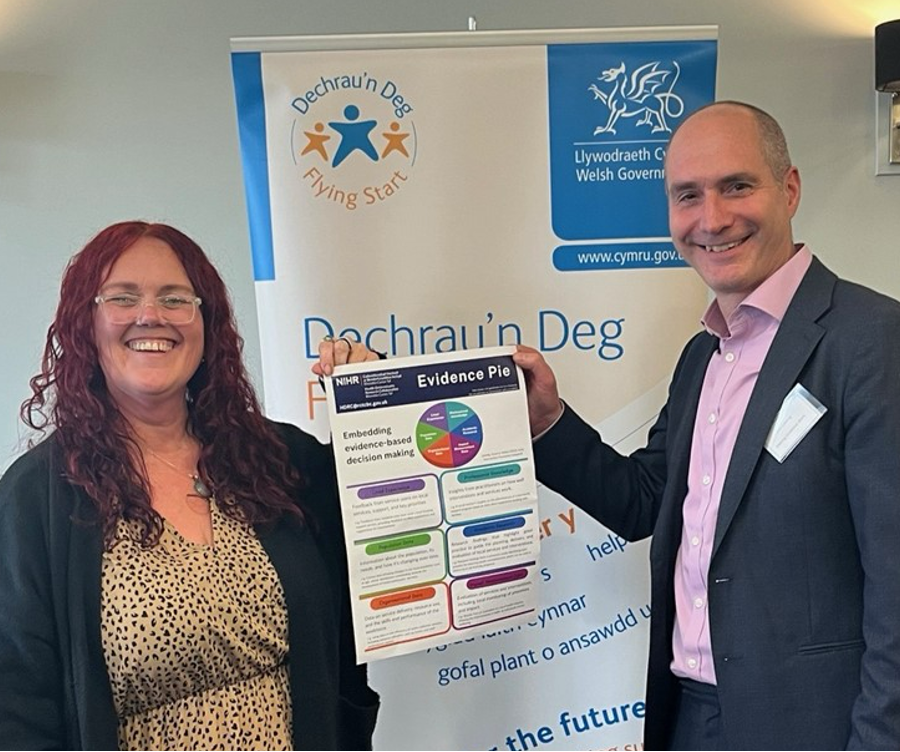
Ben here. I’m on my way home from an incredible couple of days in Swansea to take part in the Welsh Government’s national conference on ‘Prevention First: Creating the conditions for babies, children and young people to thrive’. So much to take in!
I was there to help Welsh Government create some space to think for colleagues from Flying Start and Families First, focusing on Real World Evidence, slow productivity and getting to impact.
I was also joined by Zoe Lancelott who heads up the HDRC in Rhondda Cynon Taf. We led a couple of workshops on how early years leaders can use Real World Evidence in their local context, using the learning from RCT where they have been embedding the Evidence Pie in everything the Council does. Originally created by the Early Intervention Foundation, RCT have really run with a balanced approach to different kinds of evidence in the local context.
So Zoe, this is your first ever blog, right?
“Yep I’m a newbie to blogging. I work in local government Ben – we don’t usually get time to think, let alone blog!”
Ok, well, let’s kick off then with you telling us a little bit about what the RCT Evidence Pie is and how you are using it?
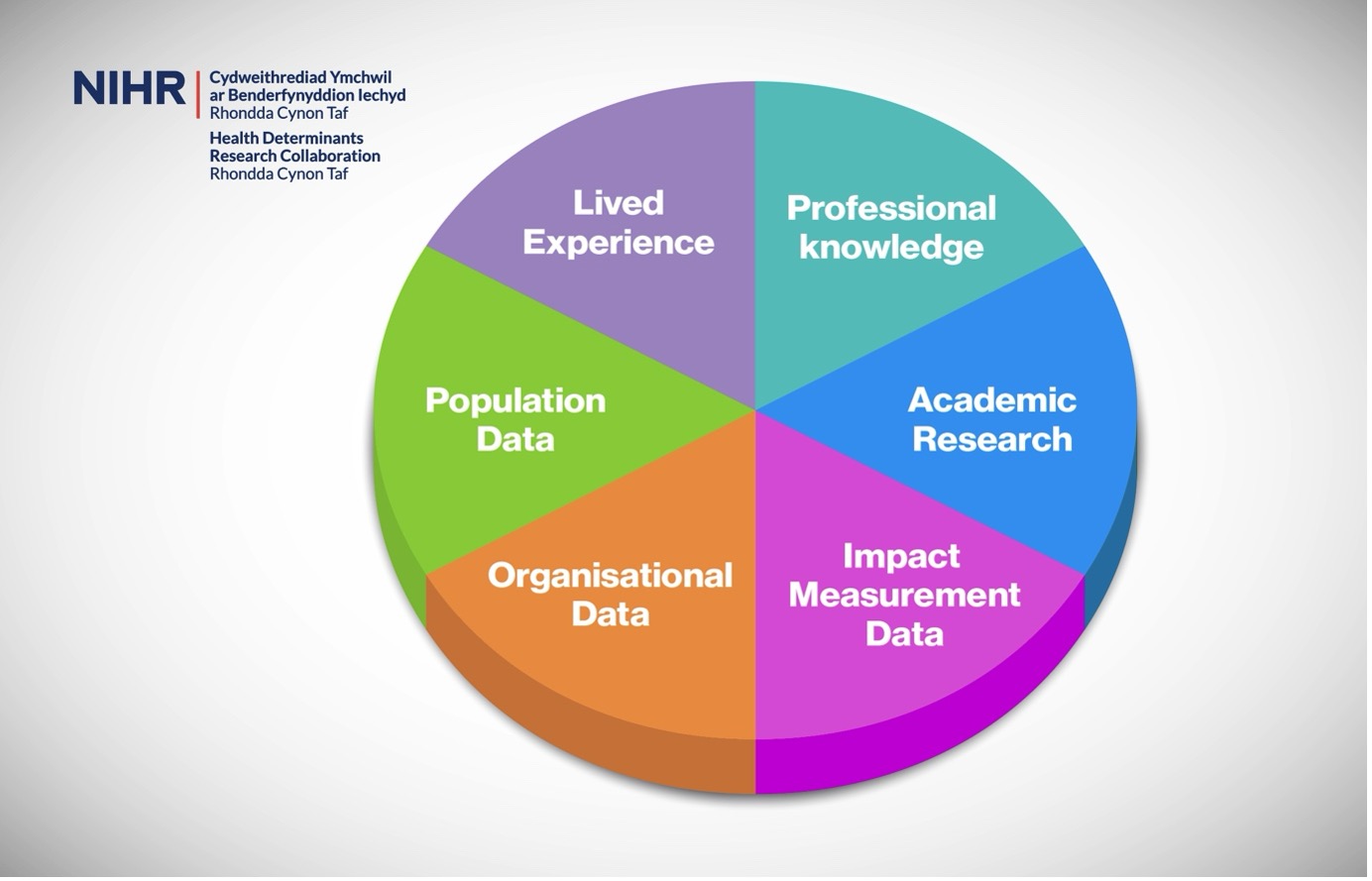
“Sure. The Evidence Pie sets out six types of evidence which are important for local decision-making: academic research, impact measurement data, organisational data, population data, lived experience and professional knowledge.
The Pie is underpinned by some simple principles – the types of evidence are all different but equally important; everyone is an expert in at least one slice of pie; and knowledge mobilisation is a team sport.
The Evidence Pie has been a complete game changer for us. It is establishing a common language and a shared understanding about what we mean when we talk about the council becoming more research active.
For too long ‘research’ has been associated with something done elsewhere by someone else rather something that is collectively owned by all stakeholders working in and with the local authority.
The Evidence Pie is everywhere in the Council now! Our Performance Management Framework uses the Pie to encourage a more evidence informed self-assessment of our annual progress as Council. It underpins the new terms of reference we’re piloting with Scrutiny Committee working groups.
We’re also using it to measure the impact of the my HDRC team (RCT’s Health Determinants Research Collaboration, funded by the National Institute for Health Research) and to identify evidence and skills gaps across the Council.“
Ok, thanks Zoe, its amazing to see how this has really taken hold in Rhondda Cynon Taf. Back to the conference, it was really interesting to hear Flying Start and Families First leaders reflect on how evidence was often used to justify positions rather than to support planning up-front.
I really liked what you said about creating the right kind of culture so that tools like the Evidence Pie don’t become tokenistic.
“That’s right Ben, we’ve been very upfront about the Evidence Pie not offering the holy grail of one single definitive truth. Gathering evidence can be a messy business and often leads to more questions than answers.
Our aim at the moment is to get Council staff excited about getting their hands dirty unearthing evidence across all six areas of the Pie, and more at ease around a range of evidence types that may offer conflicting messages.
We’re also trying to get council staff to feel less overwhelmed by having to fit it all neatly together. Synthesising the different kinds of evidence is tricky and we’re early in the journey on this. We’re fortunate that our HDRC team is multi-disciplinary, including academics, and able to support staff with this synthesis work for now.”
Interesting. I often talk about the key skill for local leaders is being at the centre of different kinds of evidence, able to make decisions based on complex, incomplete and sometimes contradictory information, or the real-world evidence that the Evidence Pie is based on. We need to support local leaders in this role, including by creating good evidence-use infrastructure and culture which is what your work is about. The synthesis work is a real challenge though, especially for leaders who are time poor and under pressure.
“We need a call to action here. How can we mobilise the research community more widely to bring synthesis expertise into the world of local service delivery? This feels like a really important collaboration opportunity.”
Good question Zoe! We heard a lot at the conference about the challenges of working with the three different kinds of real world evidence. People talked about being context data rich but often lacking analytical capacity to turn this into meaningful evidence; about science evidence being difficult to make sense of and keep up to date with; and experience evidence being the biggest challenge of all, to move beyond tokenistic approaches to give families and communities real opportunities to influence decisions. Mobilising the research community across these different types of evidence could really help.
“I don’t want to come over all Jerry Springer ‘final thought’ Ben, but early years and family support service staff are, by nature of what they do, both lived experience and professional knowledge experts – they need support to ensure this evidence is informing policy decisions at local and national levels if we are serious about creating the conditions for babies, children and young people to thrive in Wales.
We also need a wider system approach to make sure that work that is based in sound evidence isn’t derailed when key individuals move on.”
Yes, we are not in the world of quick and easy, we need a systemic approach to help local leaders to do their best work, including making space to think, plan and create.
“I do think there’s a quick win here though, by extending how our local partnerships share knowledge as evidence more formally. That way we create both a local learning legacy and we can build extra capacity for gathering and synthesizing evidence. “
Fabulous. So how do you feel about blogs now Zoe? Do you think they help with making space to think?
“I’ve enjoyed it Ben and thank you for introducing me to the world of blogs! It’s definitely something I’m going to be thinking about using for disseminating our learning from the HDRC in RCT. I also think you and I should take the Evidence Pie on tour, we make a good double act!
Did you know that the HDRCs in Southampton and Coventry also have adaptations of the Evidence Pie? Technically that makes you the grandfather of the Pie now. Or maybe the Grandpiefather!”
Thanks Zoe. I’m a very proud Grandpiefather. It has been fun doing this together, and I look forward to hearing more about what you are creating in RCT and beyond!